Introduction
Finding an affordable software stack has become a major challenge for online entrepreneurs in 2026. Major generative platforms charge heavy recurring monthly subscriptions for text generation, image creation, voice synthesis, and code generation. Consequently, marketers frequently find themselves paying multiple recurring bills each month just to maintain basic business assets. RemoteAI 2.0 Review
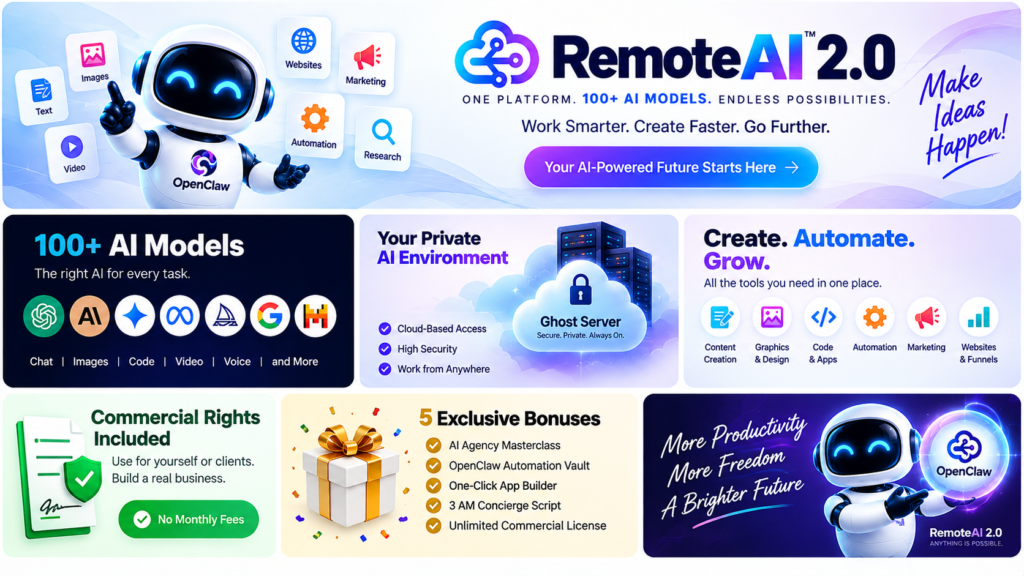
RemoteAI 2.0 enters the market promising to eliminate these recurring fees entirely. Created by established launch creators Mike McKay and Radu Hahaianu (distributed via LaunchPad and affiliated vendor networks), the platform presents a centralized workspace powered by its proprietary “OpenClaw” engine. Instead of bogging down your personal computer with high-end graphic cards or heavy local software, RemoteAI 2.0 allocates a dedicated, private cloud-hosted “Ghost Server” protected by VPN tunnels.
Check RemoteAI 2.0 Official Offer
However, does the software deliver on its bold claims of replacing dozens of paid tools for a single $17 payment? In this detailed RemoteAI 2.0 review, we break down its architecture, core tools, upsell funnel, realistic strengths, and inherent limitations to help you decide whether it fits your business.
Quick Verdict
RemoteAI 2.0 looks most interesting for marketers, freelancers, creators, small agencies, and online-business users who want several AI-related tasks managed from one dashboard instead of maintaining a collection of separate tools.
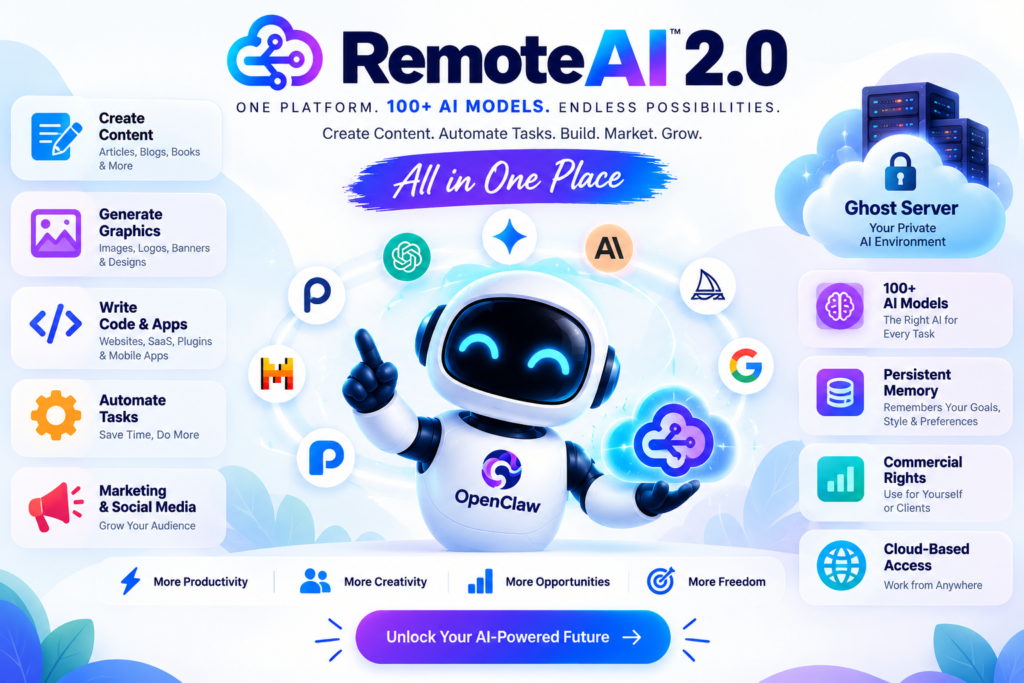
The biggest attractions are the advertised private cloud environment, OpenClaw automation layer, persistent memory, broad AI-model access, commercial rights, and low front-end launch price. The official material also includes five front-end bonuses.
However, buyers should separate those confirmed offer details from the more aggressive marketing claims.
For example, the sales material claims that users can achieve number-one Google rankings, automate income-producing activities and replace several premium AI subscriptions. The vendor’s own earnings disclaimer states that examples and testimonials should not be interpreted as guarantees and that earnings depend on the individual user.
There is also a messaging inconsistency worth noticing. The JV page says users can run multiple AI models directly on their computer and refers to using AI “locally,” while the sales page says processing happens on the company’s cloud hardware through a dedicated VPN server rather than on the user’s machine. I would clarify that architecture with support if local processing matters to you.
Bottom line: RemoteAI 2.0 may be worth exploring at its low front-end price, particularly if automation and commercial use matter to you. Still, buy it for the functions you can verify—not because of income claims, ranking promises or assumed access to every premium AI service at its official subscription tier.
What Is RemoteAI 2.0?
RemoteAI 2.0 is a cloud-based software suite built to streamline content production, basic digital asset creation, and everyday marketing workflows without incurring ongoing monthly fees.
Unlike standard local AI wrappers that force you to run demanding neural nets on your personal machine—eating up CPU power and RAM—RemoteAI 2.0 runs completely off-site. According to the creators, each user account provisions a remote private server (marketed as a “Ghost Server”). This server runs continuous background operations, ensuring your home hardware and internet connection remain unburdened.
Furthermore, the software incorporates the “OpenClaw” autonomous engine. This subsystem handles automated task distribution across an internal library of over 100 configured model endpoints. As a result, users can draft blog posts, formulate sales copy, generate marketing graphics, structure simple apps, and draft multimedia scripts inside a single consolidated dashboard.
Check RemoteAI 2.0 Official Offer
RemoteAI 2.0 Review — Key Features
1. OpenClaw Automation Engine
OpenClaw sits at the center of RemoteAI’s positioning.
Instead of functioning only like a chatbot that waits for each prompt, the vendor describes OpenClaw as an execution layer designed to handle multi-step activities.
The official sales material gives examples such as managing emails, creating sites and apps, working with social content and handling booking-related tasks.
The practical attraction is easy to understand. If the execution layer works as described, users could reduce the amount of copying, pasting and manually switching between different tools.
However, any automation that can act on external accounts should be configured carefully. Users should review permissions before connecting email, social-media accounts, payment systems or other sensitive services.
2. Private “Ghost Server”
RemoteAI advertises a dedicated VPN-based cloud server for each user.
The vendor says AI processing happens on its hardware rather than consuming the user’s local computer resources. It also says the server can remain online while a user’s computer is turned off.
That concept may appeal to people with older laptops or users who want longer automated jobs to continue without leaving their computer running.
Still, buyers should understand exactly what “dedicated” means in the service terms, particularly regarding resource limits, storage, bandwidth and fair-use conditions.
3. Advertised Access to 100+ AI Models
One of the headline claims is access to more than 100 AI models.
The sales material presents the platform as a central AI vault rather than a single-model assistant.
That could be convenient for people who regularly switch between models for writing, coding, images and research.
However, this is also an area where I would conduct extra due diligence. Model providers change names, APIs, pricing and access rules regularly. Therefore, buyers should confirm which models are currently live, whether usage limits exist, and whether access comes through official APIs, vendor-managed accounts or another arrangement.
4. Persistent Memory
RemoteAI advertises persistent long-term memory.
According to the sales page, the system is designed to remember elements such as the user’s goals, business information, preferences and writing style.
This can be useful when managing long projects because repeatedly explaining your brand or workflow becomes tedious.
At the same time, persistent memory increases the importance of understanding data-retention and deletion controls.
5. Content and Marketing Creation
RemoteAI is positioned for creating articles, books, marketing material, sales copy, scripts, graphics and social-media assets.
It also advertises website and sales-funnel creation.
These tools could save time during ideation and first-draft production. Nevertheless, AI-generated marketing content should still receive human editing, fact-checking and originality checks before publication.
6. Coding and App Creation
The official material says RemoteAI can assist with software, SaaS applications, WordPress plugins, mobile apps and games.
This does not mean a non-technical user should automatically deploy generated code without review. AI can accelerate development, but security, testing, maintenance and debugging still matter.
7. Commercial Rights
A commercial license is included with the current front-end offer according to the sales page and JV material.
That makes RemoteAI more relevant to freelancers and agencies because they can potentially use qualifying outputs for client services.
Before selling AI-generated assets, however, users should still review the terms of any underlying third-party model, media or service involved.
Check RemoteAI 2.0 Official Offer
How Does RemoteAI 2.0 Work?
Getting started with RemoteAI 2.0 requires three operational steps:
- Access the Web Dashboard: Log in to your cloud member area from any modern web browser on Mac, PC, Chromebook, or mobile device.
- Deploy the Private Workspace: The system automatically assigns your workspace on the remote server infrastructure in roughly 60 seconds without requiring terminal commands or API key configurations.
- Dispatch Tasks & Generate Assets: Select your target task (such as drafting an email sequence, rendering a display ad, or building an affiliate funnel template), enter your descriptive brief or voice command, and let the engine produce your files for download. RemoteAI 2.0 Review
Key Benefits of RemoteAI 2.0
The strongest potential benefit is consolidation.
People who already use several AI services often spend considerable time switching tools, moving information between chats and organizing outputs. RemoteAI attempts to place more of that work inside one interface.
Another benefit is cloud processing. Because the vendor says tasks run on its remote infrastructure, users do not need high-end local hardware for the advertised workflows.
Persistent memory may also reduce repeated prompting.
Furthermore, the included commercial license increases the product’s relevance for freelancers, marketers and agencies rather than restricting the software to personal projects.
Finally, the current $17 launch listing makes the front-end relatively inexpensive to investigate compared with buying several separate premium subscriptions upfront.
That said, a low purchase price only matters if the functions you specifically need work reliably.
RemoteAI 2.0 Pros and Cons
Pros
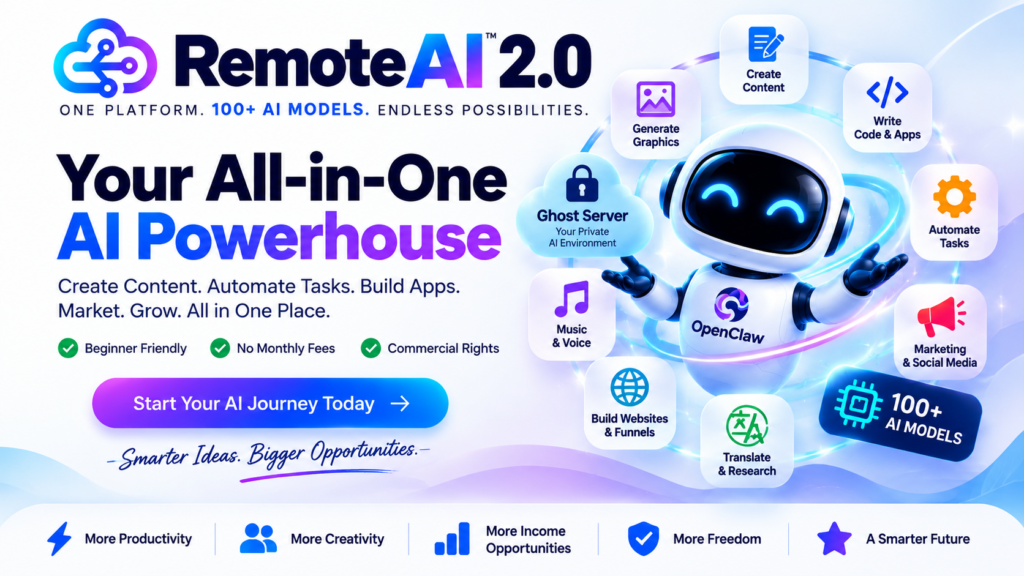
- Current launch listing shows a low $17 front-end entry price.
- Official offer uses a one-time-payment model during the launch.
- Commercial rights are included with the front-end.
- Cloud-based access means no heavy local installation is advertised.
- Vendor advertises more than 100 AI models.
- OpenClaw is designed for multi-step automation rather than simple chat only.
- Persistent memory could help with recurring projects.
- Content, coding, graphics, marketing and automation functions sit under one product.
- Five official front-end bonuses are included.
- Training and support are advertised.
- A 30-day refund policy exists for unresolved technical problems.
Cons
- I have not independently performance-tested the software.
- Some sales claims are highly promotional and should not be interpreted literally.
- Exact OTO checkout prices were not consistently verifiable from accessible official material.
- Current third-party funnel pages report conflicting prices.
- The refund is tied specifically to unresolved technical issues rather than being an unconditional no-questions-asked refund.
- The JV and sales pages use somewhat inconsistent language about whether AI runs locally or on vendor cloud hardware.
- Buyers should confirm which advertised AI models are currently available and what access limits apply.
- External automation requires careful permission and privacy management.
- Generated code, content and business actions still need human review.
Check RemoteAI 2.0 Official Offer
RemoteAI 2.0 Pricing & OTO Breakdown
Front-End: RemoteAI 2.0
Current launch listing: $17
MunchEye currently lists RemoteAI 2.0 at a $17 front-end price with a September 6, 2026 launch date. The official sales page confirms that the current launch offer uses a one-time-payment model, although its readable text does not expose the exact live checkout amount.
For that reason, always treat the amount displayed on the final checkout page as authoritative.
Order Bump
I could not verify a specific order bump from the accessible official sales page, JV page or currently indexed funnel information.
Therefore, I would not publish a specific order-bump price or feature list unless it appears at your live checkout.
OTO 1: RemoteAI 2.0 PRO
Current funnel coverage consistently identifies PRO as the first upgrade.
Reported features include expanded or unlimited usage, developer rights, additional integrations, mobile access, priority processing and premium support.
My assessment: This is the upgrade that may make the most practical sense for users who expect heavier daily usage or client work. However, front-end buyers should first determine whether they actually encounter limits before upgrading.
Exact current price: Not reliably verified from accessible official material. Current affiliate pages publish different figures, so check the live funnel.
OTO 2: RemoteAI 2.0 Enterprise
Enterprise has an indexed official upgrade page, making its feature set easier to confirm.
The vendor describes features including a RemoteAI store, Instagram and WhatsApp broadcasting, cloud storage, encryption, backups, copyright-related protection, collaboration features, an outsourcer license, training and direct support.
My assessment: Enterprise makes more sense for an agency, team or business using RemoteAI to manage several projects. A solo beginner testing basic AI creation probably does not need it immediately.
Exact current price: Verify at checkout.
OTO 3: RemoteAI 2.0 DFY
Current funnel information describes the DFY tier as a collection of ready-made commercial assets and marketing training.
Reported components include commercial rights to several existing software products, affiliate marketing training and prepared software-review content.
My assessment: This is a convenience upgrade rather than an essential RemoteAI feature upgrade. Skip it if you prefer creating your own assets or do not plan to promote digital products.
OTO 4: RemoteAI 2.0 Reseller
Current funnel coverage describes Reseller as a rights package for promoting RemoteAI itself.
Reported inclusions include reseller commissions plus marketing pages, sales materials, a members area and vendor-provided customer/technical support.
My assessment: This is relevant mainly to experienced affiliates or product sellers. Normal users who simply want the software can skip it.
OTO 5: RemoteAI 2.0 IMX Bundle
The IMX Bundle is positioned as a broader marketing and software package rather than a core RemoteAI feature tier.
Current funnel information reports additional products, email-marketing resources, white-label software, coaching, video tools and outsourcing training.
My assessment: Consider this only if you specifically want the additional marketing products. Buying a bundle simply because it contains more items rarely improves results.
OTO 6: RemoteAI 2.0 WhiteLabel
The WhiteLabel upgrade has its own publicly indexed vendor page.
It is designed for buyers who want to rebrand RemoteAI under their own business identity. The vendor advertises logo replacement, custom branding, custom-domain use and the ability to sell the rebranded software according to the applicable license.
My assessment: White-label rights are unnecessary for the majority of buyers. They become useful only if you already have the audience, support capacity and business plan required to sell software under your own brand.
Exact current price: Verify on the live upgrade page.
RemoteAI 2.0 Bonuses
The official front-end page currently lists five bonuses.
Bonus 1: AI Agency Masterclass
Training focused on finding clients and selling AI-related services.
Bonus 2: OpenClaw Automation Vault
A collection of prebuilt workflow ideas and scripts for automating activities such as content and customer-support processes.
Bonus 3: One-Click App Builder
A tool positioned for packaging AI-generated logic into software or application projects.
Bonus 4: “3 AM Concierge” Script
An automation workflow aimed at monitoring booking or ticket-related opportunities.
Bonus 5: Unlimited Commercial License
Commercial usage rights for eligible creations produced with the system.
The bonuses add useful context for people interested in client work. However, buyers should treat the vendor’s monetary “value” assigned to each bonus as marketing valuation rather than an independently established market price.
Check RemoteAI 2.0 Official Offer
RemoteAI 2.0 Refund Policy
This deserves careful reading.
The vendor has an official 30-day money-back policy, but the wording does not describe an unconditional refund for any reason.
Instead, the refund policy says buyers can receive a full refund if they encounter technical problems that the vendor cannot resolve. It also says approved refunds are processed immediately, with funds generally appearing within four to five business days depending on the payment method.
Therefore, I would describe the policy as:
30-day technical-issue money-back guarantee, subject to the vendor being unable to resolve the problem.
That wording is more accurate than simply saying “risk-free 30-day guarantee.”
Who Should Buy RemoteAI 2.0?
RemoteAI 2.0 may be worth considering for:
Affiliate marketers who create reviews, websites, funnels and promotional material regularly.
Freelancers who provide writing, marketing, design or basic AI-assisted services.
Content creators who want one place for text, graphics, scripts and other media-related workflows.
Small agencies interested in commercial rights, collaborative workflows and automation.
Online-business owners who currently move between several AI tools for repetitive tasks.
Developers and no-code builders who want AI assistance during prototyping, coding and product creation.
It may also appeal to people who own modest computers and prefer cloud processing rather than running large AI workloads locally.
Who Should Avoid RemoteAI 2.0?
RemoteAI will probably be less attractive if you only use AI occasionally.
A dedicated service such as ChatGPT, Claude or Gemini may be simpler if you mainly need one assistant for research, writing or everyday questions.
You should also avoid buying RemoteAI solely because you expect automatic income.
The vendor’s own earnings disclaimer explicitly states that testimonials and examples do not guarantee earnings.
Finally, buyers who need enterprise-grade compliance, documented data residency, formal SLAs or highly specific security certifications should verify those requirements directly rather than assuming that a VPN or encrypted connection satisfies them. RemoteAI 2.0 Review
RemoteAI 2.0 Review FAQs
1. What is RemoteAI 2.0?
RemoteAI 2.0 is a cloud-based AI platform that the vendor positions around its OpenClaw automation engine, a private Ghost Server, access to more than 100 AI models, persistent memory, content creation and business automation.
2. How much does RemoteAI 2.0 cost?
The current MunchEye launch listing shows a $17 front-end price. Launch pricing can change, so check the final live checkout before purchasing.
3. Is RemoteAI 2.0 a monthly subscription?
The current official sales page advertises front-end access as a one-time payment during the launch rather than a monthly subscription.
4. Does RemoteAI 2.0 include commercial rights?
Yes. Commercial rights are advertised on both the official sales and JV pages. Review the final license terms before delivering client work.
5. Does RemoteAI 2.0 include more than 100 AI models?
The vendor advertises access to 100+ AI models. Buyers should confirm the exact live model list and applicable usage limits inside the platform.
6. Can RemoteAI 2.0 guarantee Google rankings?
No software should be treated as capable of guaranteeing the number-one position for every keyword. Rankings depend on competition, content quality, authority, technical SEO, backlinks, search intent and algorithm changes.
7. Can RemoteAI 2.0 make money automatically?
There is no guaranteed income. The vendor’s own disclaimer states that examples and testimonials do not promise earnings.
8. Does RemoteAI 2.0 have a money-back guarantee?
Yes, but it is conditional. The official policy provides a 30-day refund for technical problems the support team cannot resolve.
9. Do I need every RemoteAI 2.0 OTO?
No. Most buyers should start with the front-end and only upgrade when a specific additional feature, license or capacity solves a real need.
10. Is RemoteAI 2.0 suitable for beginners?
The vendor positions it as beginner-friendly and includes training. However, beginners should still learn how to review AI-generated content, protect connected accounts and verify automated actions before relying on them professionally.
Final Verdict
To conclude our RemoteAI 2.0 review, the platform offers a practical, budget-friendly toolkit for entrepreneurs tired of paying endless monthly subscriptions. By housing diverse AI tools on an external cloud server, it lowers the entry barrier for marketers operating basic computers.
However, buyers should ignore the exaggerated sales pitch claims of instant wealth or automated app empires. RemoteAI 2.0 serves best as an accessible digital assistant for drafting blog content, structuring marketing copy, and assembling graphic concepts. If you enter with realistic expectations, the $17 entry price delivers sound practical value.
Check RemoteAI 2.0 Official Offer